
In Provence-Alpes-Côte d’Azur, the aires that let you sleep for nothing are inland, and on the coast you pay. That is the routing decision to make first, before you pick any villages.
Two examples set the gap. At Forcalquier, in the Alpes-de-Haute-Provence, the municipal aire d’étape et de services is listed as free, 48 hours, open all year, with a fresh water fill and disposal for grey and black water. At Sainte-Maxime, in the gulf of Saint-Tropez, the aire on the boulevard des Mimosas costs 12 euros a day from April 1 to September 30 and 7 euros a day from October 1 to March 31, also capped at 48 hours, with waste water disposal and a water fill in free access. Verified August 2, 2026 on the Alpes de Haute Provence Tourisme listing and on the town of Sainte-Maxime’s own site.
The borne, and how it wants to be paid
On a French aire, parking and services are priced separately. “Free” on a map means the parking. It almost never means the borne, the service pillar.
Sainte-Maxime is the comfortable version. The automatic till takes coins from 0.10 to 2 euros, notes from 5 to 20 euros, and a contactless card, and the exit barrier takes a card only. So a bank card is not optional there: it is how you get back out.
Fontvieille, in the Alpilles, is the version that catches people. The commune says entry to the aire is through a payment terminal and that water is not included with the pitch, you buy it at the terminal. It publishes no price and no stay limit. Turn up with a card and coins, and read the terminal before you settle in.
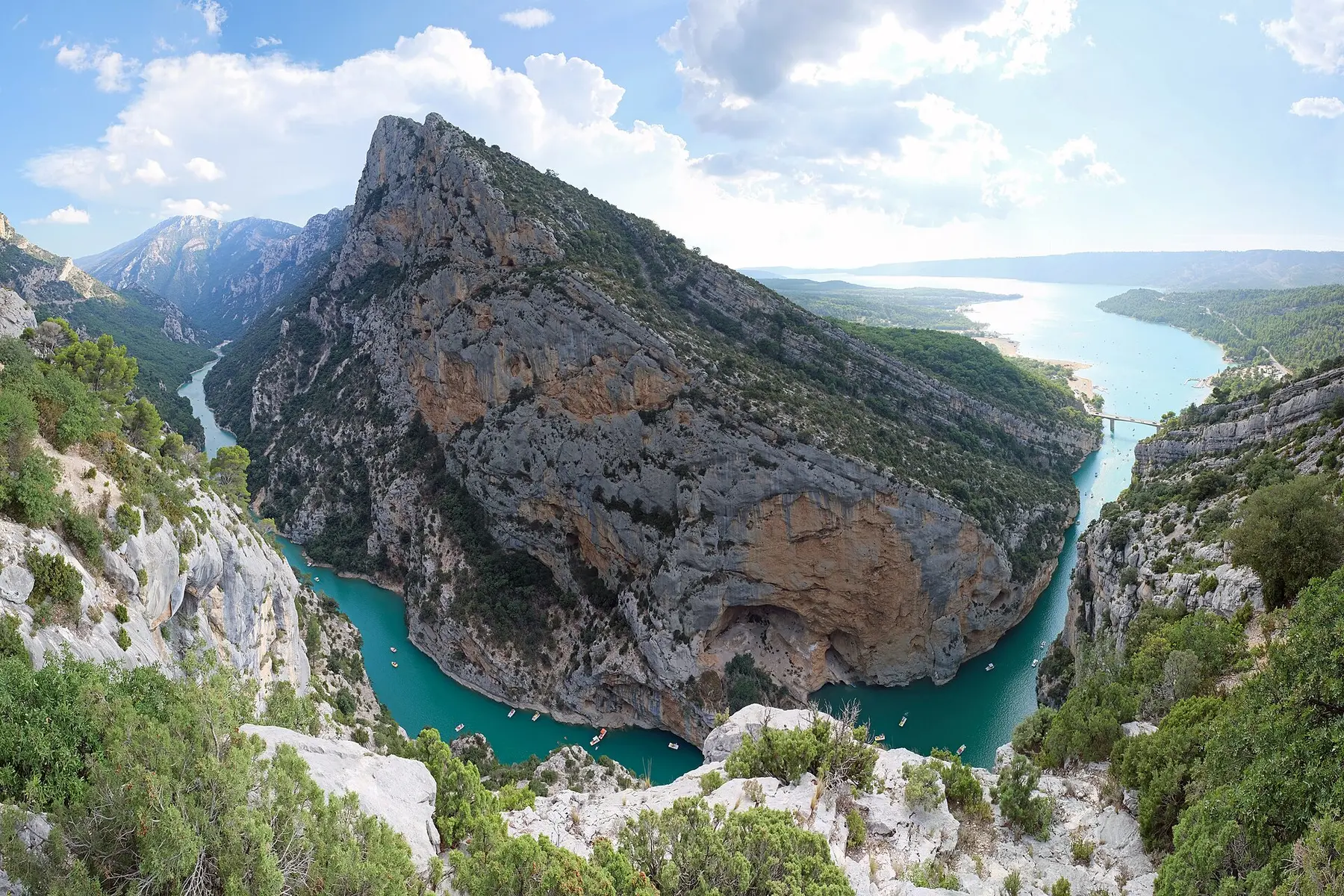
Trigance, above the Verdon gorge, publishes nothing at all. Its camping-car page gives directions to the parking lot at the west entrance of the village off the D90, and stops there. Bring coins, and let the sign at the entrance decide how long you stay.
In summer it is not the price that closes things, it is fire
This is what most Provence itineraries miss. From June to September, access to the forest massifs is regulated, and it changes daily.
In the Bouches-du-Rhône, the period runs June 1 to September 30 inclusive, and the next day’s access conditions are updated around 6pm, massif by massif and commune by commune, under the prefectoral order of April 22, 2025 as amended. In the Var, the prefectoral order of June 19, 2018 as amended regulates entry, driving and parking in the massifs; the next day’s map is published before 7pm, and the red level means access prohibited.
The practical version: in the evening, before you commit to where you sleep tomorrow, check the department’s map. A forest road that was open yesterday can be shut today, and parking is part of what gets prohibited.
The Calanques, all year
Between Marseille and La Ciotat, the Parc national des Calanques prohibits bivouac and camping by any means, and its notice spells out that this includes sleeping in a vehicle, a habitable trailer or any other mobile shelter. It names the Route des Crêtes, the route de la Gineste, the D559 between Marseille and Cassis, the D141 between Cassis and La Ciotat, and the roads down to Sormiou and Morgiou. The park states 68 euros per person for bivouac and 135 euros for a fire. This one is not seasonal.
Everywhere else it is the commune, and it is the sign
Outside the national park, the rule is set locally. Article R111-34 of the Code de l’urbanisme lets the local planning document prohibit camping outside designated grounds in certain zones, and lets the mayor prohibit it by arrêté. The same article adds the sentence that decides how you should behave: those prohibitions are only enforceable if they have been made public by a notice at the mairie and by signs at the usual access points.
So read the sign at the entrance. It outranks this page and every other one.
Building the week
Base inland and go down to the sea for the day. The country around Forcalquier, the Alpilles and the Verdon all keep the coast within a day trip without paying coastal rates to sleep, and Sainte-Maxime becomes the night you choose to pay for rather than the one you are stuck with.
Next: the Provence-Alpes-Côte d’Azur region page with the named communes, what an aire is if the word is new, and the France bivouac and camping rules for why the bivouac rule does not rescue a night spent in a vehicle.
Sources
- Aire d'étape et de services municipale de Forcalquier, Alpes de Haute Provence Tourisme
- Stationnement des autocaravanes, Ville de Sainte-Maxime
- Aire de camping-cars, Commune de Fontvieille
- Camping-cars, Commune de Trigance
- Camping sauvage et bivouac, Parc national des Calanques
- Accès aux massifs forestiers des Bouches-du-Rhône, Préfecture des Bouches-du-Rhône
- Carte d'accès aux massifs, Préfecture du Var
- Article R111-34, Code de l'urbanisme, Légifrance
When a source is not in English, follow the link for the official wording.