

Spain has no national wild camping law, so there is no one answer. What there is instead is a line that runs the length of the country: parking is not camping. Keep the van on its wheels with nothing deployed and you are parked, covered by traffic law like any other vehicle. Put something out and you are camping, which the region’s tourism law and the town’s ordinance control. That distinction decides most Spanish nights.
The three conditions
The Dirección General de Tráfico wrote them down in Instrucción PROT 2026/04, signed March 11, 2026. Traffic law covers the maneuver when all three hold:
- Engine off, and the vehicle touches the ground only through its wheels. No stabilizer legs, no other device except chocks.
- The vehicle takes up no more surface than it does closed. No awning, no chairs, no table.
- It emits no fluids and no noise to the outside.
The document puts it in four words, “Estacionar no es acampar”, parking is not camping, and says the presence of occupants inside the vehicle is entirely irrelevant to whether it is correctly parked. So sleeping in the vehicle is not the problem. One wrinkle: the DGT explicitly allows chocks, while Catalonia’s tourism decree (Decret 75/2020, article 213-22) describes the not-camping vehicle as resting on its own wheels without them. In Catalonia, leave the chocks in the locker. Checked August 6, 2026.
The town can still restrict you
This is where most Spain guides stop. The same instruction cites the Tribunal Supremo judgment of March 13, 2018: a municipal traffic ordinance can limit how long you park, and can prohibit motorhomes and caravans from camping on urban roads and adjacent spaces, outside the zones the town itself authorizes.
Benalmádena, on the Málaga coast, shows how tight that gets. Its ordinance, published in BOP Málaga 86 on May 6, 2022, restricts motorhome parking on urban roads and adjacent spaces, outside its own designated área, to 9:00 to 22:00 from June 21 to September 21, and 9:00 to 21:00 the rest of the year. That leaves no legal overnight window, and acampada libre is prohibited across the municipality. Search “ordenanza autocaravanas” plus the town name before you go. That document, not the national law, decides your night.
On the coast, national law applies
Article 33.5 of Ley 22/1988 de Costas prohibits unauthorized vehicle parking and circulation, plus encampments and camping, across the dominio público marítimo-terrestre, the state-owned coastal strip. The DGT prices the penalties under article 97 of the same law: a minimum of 40 euros per square meter per day for camping, and 50 to 150 euros for unauthorized parking or driving. The gravel between the beach and the first road is not a stopover, however many vans are on it.
Every region draws the line differently
Camping belongs to the comunidades autónomas, and they have not converged. Galicia is the strictest: Decreto 159/2019, published in DOG 246 on December 27, 2019, prohibits acampada turística outside authorized campamentos de turismo in article 1.4, and defines it as any camping that gives people temporary accommodation. Catalonia, Cantabria, Asturias and the Basque Country instead write the parking-is-not-camping test into their own tourism decrees. Andalusia’s Decreto 26/2018 makes the área de pernocta a category of tourist accommodation and hands plain parking back to municipal ordinances and the Reglamento General de Circulación. Those regional texts are reproduced verbatim in the DGT instruction, checked August 6, 2026. Carrying one region’s rule across a regional border does not work here, which is why our Spain country page names the body behind each rule.
National parks write their own, and they are tighter
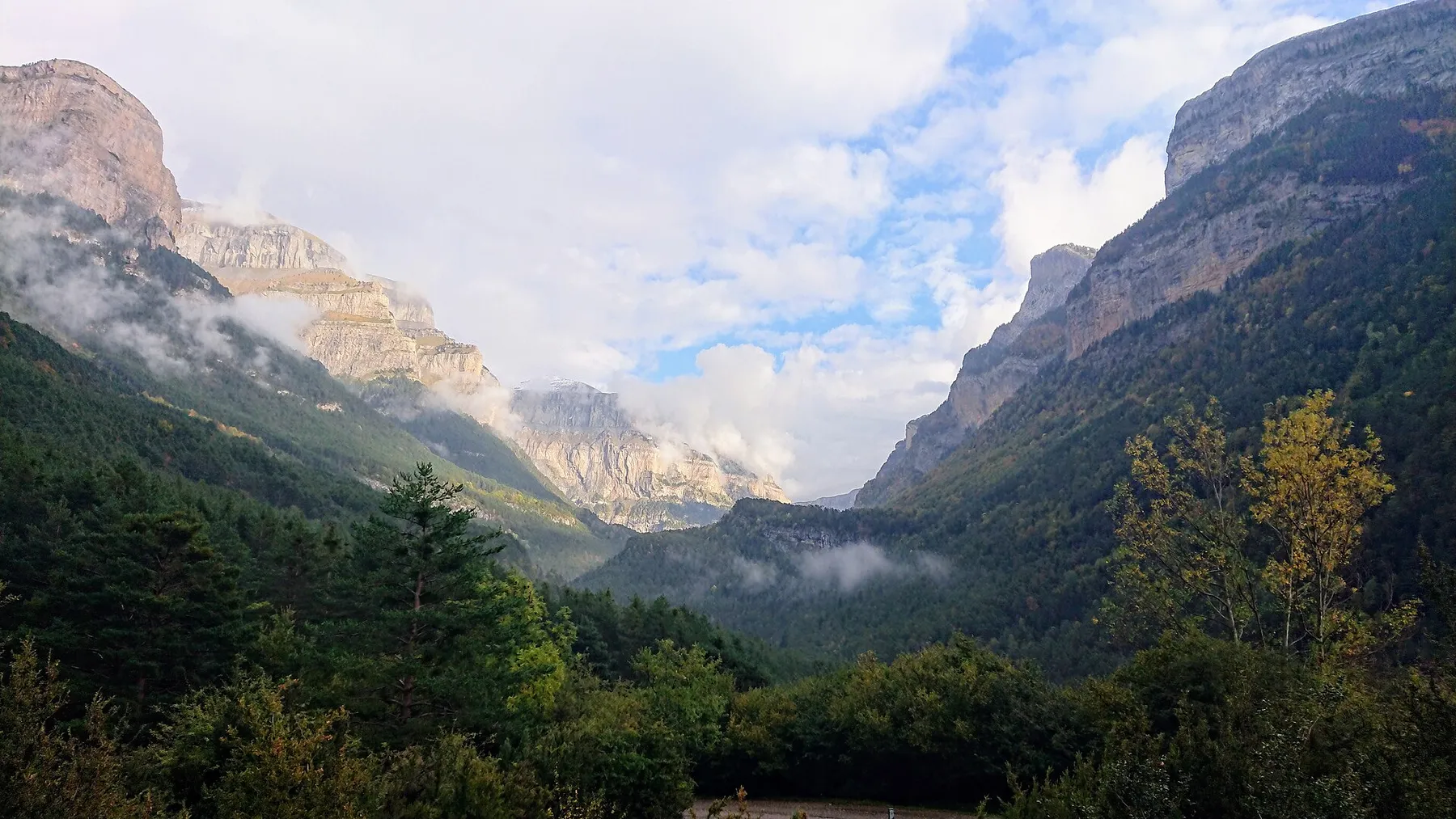
In Parque Nacional de Ordesa y Monte Perdido, free camping is prohibited outright. Bivouac is allowed only above set altitudes: 2,550m in the Pineta sector, 1,800m in Escuaín, 1,650m in Añisclo. It has been banned across the whole Ordesa sector since February 9, 2022, the one exception being the Góriz camping zone, which has limited capacity and requires advance booking. No more than three nights in the same sector, and tents may only stand from one hour before sunset to one hour after sunrise. That is one park, published by the ministry that runs it and checked August 6, 2026. Every other park sets its own, so read its page first.
What to actually do
Plan the night around an área de autocaravanas, the Spanish stopover. Parked anywhere else, hold all three conditions: wheels on the ground, nothing deployed, nothing discharged. On the coast and in the parks, assume the ground is regulated, not tolerated. And where a sign at the entrance disagrees with any website, including this one, the sign wins. The Spain map shows what is officially designated, and the rules pages cover the countries you cross into next.
Sources
- Instrucción PROT 2026/04, Autocaravanas, Dirección General de Tráfico
- Ley 22/1988, de 28 de julio, de Costas, consolidated text, BOE
- Decreto 159/2019, ordenación de los campamentos de turismo, DOG 246, Xunta de Galicia
- Visitor rules, Parque Nacional de Ordesa y Monte Perdido, MITECO
- Ordenanza de estacionamiento y pernocta de autocaravanas, Ayuntamiento de Benalmádena, BOP Málaga 86, May 6, 2022
- Decreto 26/2018, ordenación de los campamentos de turismo, Junta de Andalucía
When a source is not in English, follow the link for the official wording.